
Personal finance
Investing in dollars from Colombia: what you need to know
Diversifying in dollars is a common goal in Colombia. We explain advantages, currency risks, and how to do it with small amounts.
September 30, 2026 6 min readCityFraction editorial team
Key points
- Investing in dollar-linked assets diversifies your wealth against the economy and local currency.
- The exchange rate can work for or against you; it is not a sure bet.
- With fractions of 50 USD you can start with small amounts and pay with PSE, card, Nequi/Bre-B, PayPal or bank transfer.
- Income and earnings from abroad usually must be declared in Colombia; consult an advisor.
- Diversifying in dollars does not replace the emergency fund in pesos.
Why so many Colombians seek the dollar
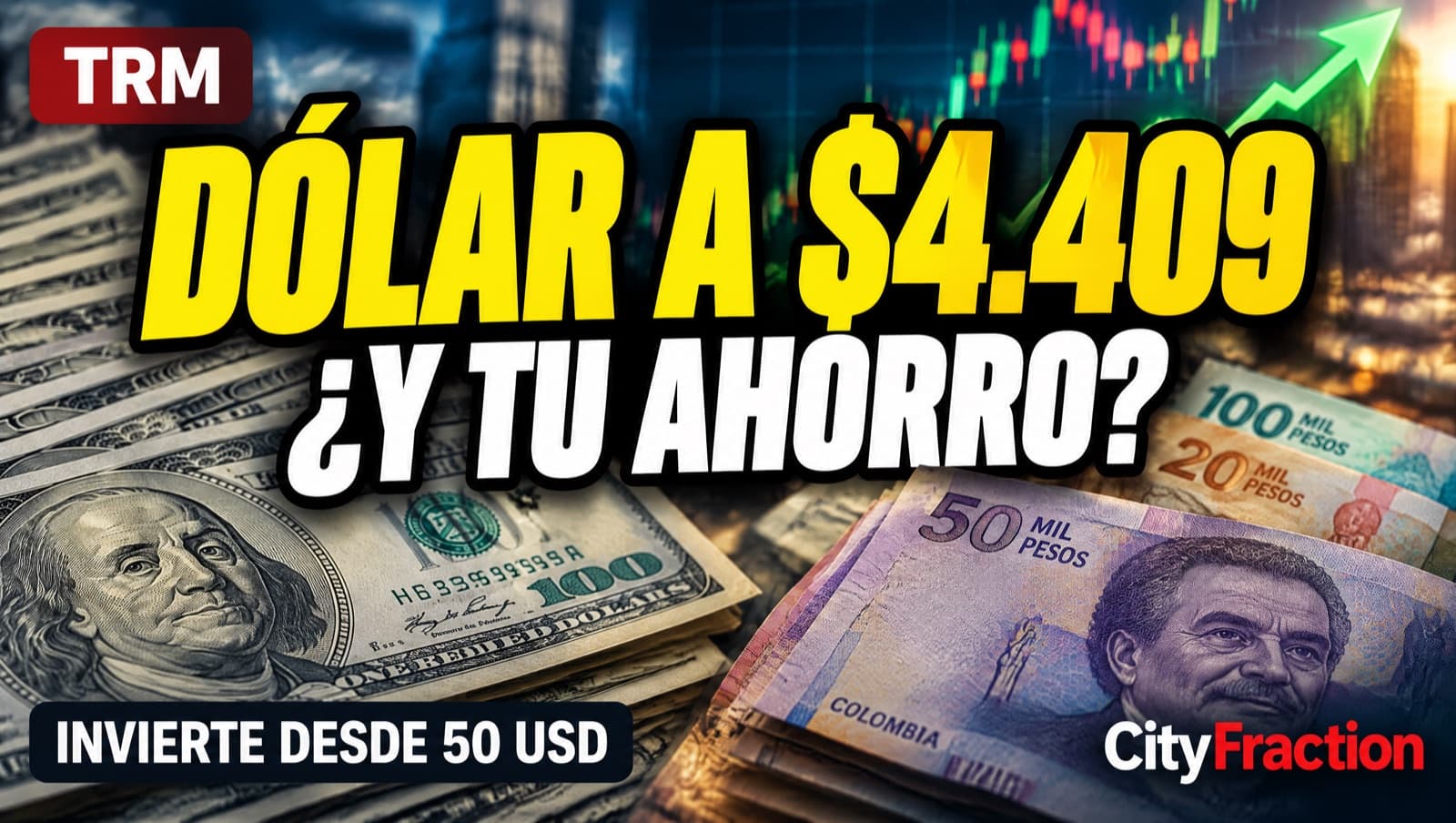
For many Colombian families, having part of their wealth in dollars is a way to diversify. The peso has had periods of sharp depreciation against the dollar, and those who had savings in dollars saw their value in pesos increase. Also, expenses like travel, studies abroad, or technology are often tied to the dollar.
The underlying logic is not to depend on a single economy. If all your income, savings, and assets are in pesos and in Colombia, any local shock affects you completely. Having a portion in another currency reduces that concentration.
But diversification works both ways: there are periods when the peso strengthens and dollar assets lose value in pesos. That’s why it’s about balancing, not betting.
The effect of the exchange rate on your income
When you invest in CityFraction asset fractions, income is calculated in dollars. If you live in Colombia and spend in pesos, the real value of that income for you depends on the exchange rate. Let’s see an example with illustrative rates, not forecasts.
The income in dollars is the same in all three scenarios; what changes is its equivalent in pesos. This shows that exchange rate risk is real and diversifying in dollars does not guarantee more pesos in the future.
The same applies to capital. If you bought fractions when the dollar was high and then the peso strengthens, converting to pesos will show a lower value even if the asset performs well. That’s why it’s best to think in dollars to measure asset performance and in pesos only when you spend, without drawing hasty conclusions from short-term exchange rate movements.
| Rate scenario (illustrative) | COP per USD | Annual income in pesos | Value of 1,000 USD in pesos |
| Peso strengthens | 3.600 | 432.000 COP | 3.600.000 COP |
| Stable rate | 4.000 | 480.000 COP | 4.000.000 COP |
| Peso weakens | 4.400 | 528.000 COP | 4.400.000 COP |
Hypothetical exchange rates for illustration only. The 120 USD income equals an estimated 12% return and is not guaranteed.
How to invest from Colombia with small amounts
Traditionally, investing abroad required opening accounts outside the country, high minimum amounts, and complex procedures. With fractional investment platforms, you can start with 50 USD, the value of one fraction in the primary market.
At CityFraction you can pay by card or PSE through ePayco, which is the default method, or with PayPal, Nequi/Bre-B, bank transfer, or balance. Check options and conditions at /payments. Buying fractions has no commission.
You can choose among short-term rental properties in Cartagena, Miami, Madrid, and Capri, or cars on Turo in Miami. Combining assets in Colombia and abroad is also a way to diversify within the platform.
- Fraction in primary market: 50 USD.
- Commission-free purchase.
- Payments: ePayco (card/PSE), PayPal, Nequi/Bre-B, transfer, balance.
- Net rents credited to balance daily.
Taxes: the basics you need to know
If you are a tax resident in Colombia, you generally must declare your income from national and foreign sources, as well as your assets, including those abroad. The rents from your fractions and gains from sales may need to be included in your tax return, and some taxpayers with foreign assets above certain amounts have additional reporting obligations.
Details depend on your situation, amounts, and the rules in effect each year. CityFraction does not offer tax advice: each user is responsible for their taxes. Keep records of purchases, sales, rents received, and withdrawals, and consult an accountant or tax advisor.
Good annual record-keeping saves you time, money, and worries when filing.
This information is general. Consult a tax advisor about your particular case.
How much of your assets to hold in dollars
There is no single figure. It depends on your future expenses, goals, and risk tolerance. If you plan to study or live abroad, a higher proportion in dollars makes sense. If all your expenses will be in Colombia, a moderate proportion may be enough to diversify.
Some investors use a simple rule: keep emergency funds and short-term expenses in pesos, and allocate part of long-term investments to dollar assets. This way, exchange rate volatility doesn’t affect daily life.
The key is to define a proportion and maintain it, rebalancing once or twice a year instead of reacting to every dollar movement.
Don’t buy dollars out of fear after a sharp rise. Invest regularly to average the exchange rate.
A gradual entry plan
A practical way to start is to set a monthly amount in pesos you can sustain, for example the equivalent of one or two fractions, and buy them on the same day each month. This way, you don’t have to guess the best time to buy dollars: sometimes the rate will be high, other times low, and over time it averages out.
Suppose you invest 200,000 COP per month. If the rate is 4,000, it’s enough for one 50 USD fraction; if it drops, you have a little left to accumulate in your balance until you complete another. Over months, dollar rents arrive daily to your balance and you can reinvest or withdraw them.
This approach reduces the stress of following the dollar daily and turns diversification into a habit, which is what really builds wealth long term.
Risks beyond exchange rate
Besides the exchange rate, investing in fractions carries asset-specific risks: variable occupancy, operating costs, regulatory changes in cities, depreciation in cars, and liquidity depending on the secondary market. Selling costs 2% between users or 3% for instant sale.
It’s also important to understand the structure: CityFraction operates through a securitization vehicle in Luxembourg and a company in Florida, USA. It’s not a bank, not supervised by Colombia’s Financial Superintendence, nor registered with the SEC. Read /legal#riesgos and /como-funciona before investing.
Frequently asked questions
Can I invest in dollars from Colombia with little money?
Yes. At CityFraction each fraction costs 50 USD in the primary market and you can pay with PSE, card, Nequi/Bre-B, PayPal, or transfer.
Does investing in dollars always give me more pesos?
No. If the peso strengthens, your dollar assets and rents are worth fewer pesos.
Do I have to declare rents in Colombia?
If you are a tax resident in Colombia, you generally must declare foreign income and assets. Consult an advisor.
Are CityFraction fractions supervised by the SFC?
No. CityFraction is not a bank nor supervised by Colombia’s Financial Superintendence or registered with the SEC.
Buy your first fractions
Choose one or several assets and pay in seconds.
Conversation
What do you think of this article?
Educational content. Returns and figures are estimates or illustrative examples and do not constitute advice or guarantee. Read the risk information.