

Personal finance
Before investing: the emergency fund and the $400 figure
Investing without a liquidity cushion forces selling at the wrong time. We explain how to build an emergency fund before buying fractions.
November 7, 2026 4 min readCityFraction editorial team
Key points
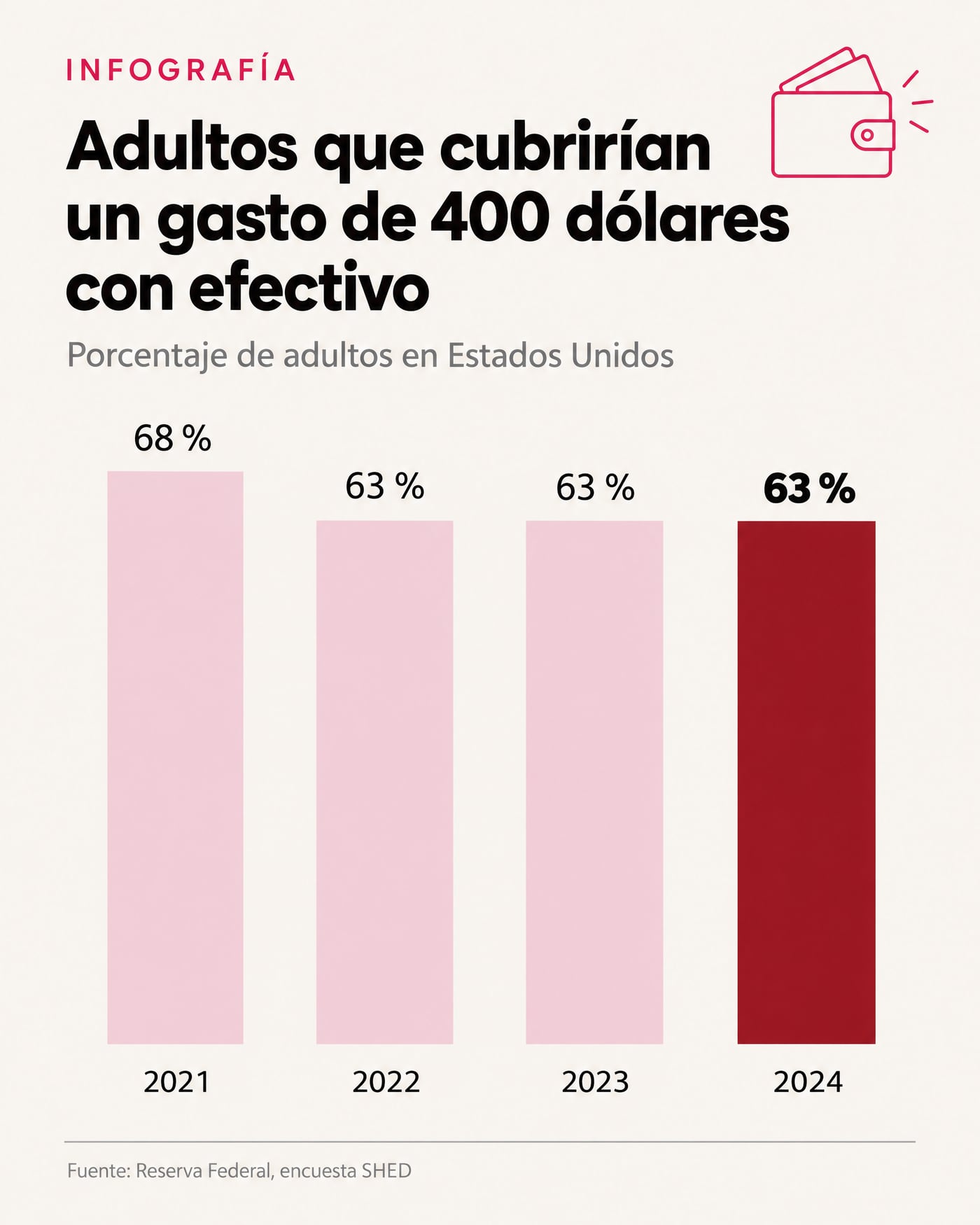
- 63% of adults in the United States could cover an unexpected $400 expense with cash or equivalent.
- That proportion was 68% in 2021 and has not returned to that level.
- An emergency fund prevents having to sell investments at a bad time.
- Real asset fractions are medium- and long-term investments, not a substitute for liquid savings.
Infographic
Adults who would cover a $400 expense with cash
Percentage of adults in the United States
View data in table
| 2021 | 68 % |
| 2022 | 63 % |
| 2023 | 63 % |
| 2024 | 63 % |
Source: Federal Reserve, SHED survey
The $400 figure
Every year the U.S. Federal Reserve publishes the Survey of Household Economics and Decisionmaking (SHED). In its 2024 report, published May 28, 2025, based on an October 2024 survey of over 12,000 adults, 63% said they could cover an unexpected $400 expense with cash or equivalent alone.
The proportion was the same as in 2022 and 2023 but lower than the 68% in 2021. That means more than a third of adults in one of the richest countries in the world would have to borrow, sell something, or skip payments to handle a small emergency.
Why the emergency fund comes first
Emergencies happen: a repair, a health issue, loss of income. Without available savings, a person must borrow, often on expensive credit cards, or sell investments at the worst time. That’s why financial planners recommend building an emergency fund before investing in long-term assets.
A common rule is to save three to six months of essential expenses in a liquid, safe instrument. The right amount depends on income stability and family responsibilities.
| Stage | Goal | Where |
| 1 | One month of expenses | Savings account |
| 2 | Three to six months of expenses | Low-risk liquid savings |
| 3 | Long-term investment | Diversified assets |
General example; adjust it to your situation.
Liquidity: the difference between saving and investing
A real asset, like a rental property or car, can generate income and appreciate, but it can't always be sold quickly without losing value. At CityFraction, you can sell your fractions on the secondary market or use instant sale, but there's no guaranteed timeframe to find a buyer and sales have fees.
That's why fractions should be considered a medium- to long-term investment. Emergency money should be kept somewhere you can access it immediately and without losses.
How to build the fund
- Calculate your essential monthly expenses: housing, food, transport, utilities, and health.
- Automate a fixed savings amount as soon as you receive your income.
- Keep it separate from your daily spending account.
- Replenish the fund every time you use it.
- Only then, start investing gradually.
And then, invest consistently
Once you have your cushion, investing small amounts regularly is usually more sustainable than waiting to have a large sum. With fractions from 50 USD, you can start small, diversify across assets, and reinvest part of your daily income.
All investments carry risks, including capital loss. The returns of CityFraction assets are estimated and not guaranteed.
Common mistakes when starting to invest
Many people start investing with money they will need soon, like tuition or debt payments. When the time comes, they have to sell quickly, sometimes at a loss or with fees. Others invest everything in a single asset attracted by high returns, without considering what would happen if that asset has a bad year.
The solution is easy to say but hard to practice: separate money by goals and timelines. Short-term money goes to liquid savings; long-term money goes to diversified investments. With this separation, an emergency won't force you to undo your investment plan.
Conclusion
Everyone's first investment is their stability. An emergency fund lets you keep your investments during tough times instead of selling at a loss. Build it first, then invest calmly.
Frequently asked questions
How much should an emergency fund have?
A common reference is three to six months of essential expenses, depending on your income stability.
Can I use my fractions as an emergency fund?
Not recommended. Selling them can take time and has fees; they are a medium- to long-term investment.
What does the Federal Reserve survey say?
That 63% of adults in the United States would cover a $400 expense with cash or equivalent in 2024.
Fonts
Public data consulted for this item. Figures may be updated after the consultation date.
- 1.Federal Reserve: Economic Well-Being of U.S. Households in 2024 (press release May 28, 2025) · consultado el October 12, 2026
- 2.CityFraction: frequently asked questions (fees, rents, and terms) · consultado el October 12, 2026
Explore open properties
Accommodations with fractions from 50 USD.
Conversation
What do you think of this article?
Educational content. Returns and figures are estimates or illustrative examples and do not constitute advice or guarantee. Read the risk information.