
Fundamentals
Crowdfunding in Europe: requirements of Regulation 2020/1503
Europe regulated crowdfunding with a common regulation. We explain its main rules and the protections it seeks for small investors.
November 8, 2026 4 min readCityFraction editorial team
Key points
- Regulation (EU) 2020/1503 regulates crowdfunding services across the European Union.
- Projects have a limit of 5 million euros within a 12-month period.
- Platforms must assess the knowledge of inexperienced investors and simulate their ability to bear losses.
- The regulation aims for transparency, clear information, and risk warnings.
Infographic
European regulation on crowdfunding
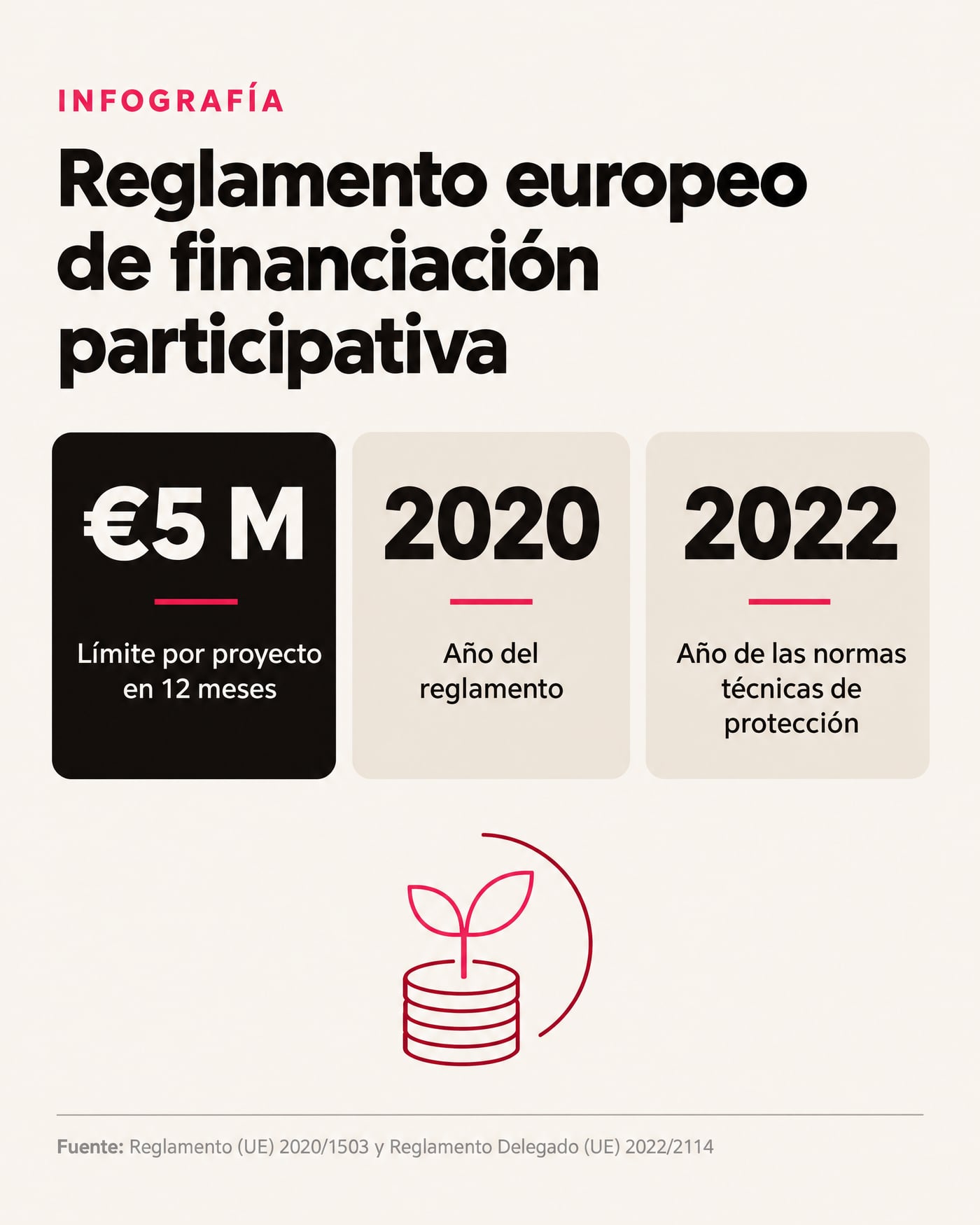
View data in table
| Limit per project in 12 months | €5 M |
| Year of the regulation | 2020 |
| Year of the technical protection standards | 2022 |
Source: Regulation (EU) 2020/1503 and Delegated Regulation (EU) 2022/2114
A common rule for Europe
Until 2021, each European country regulated crowdfunding platforms in its own way. Regulation (EU) 2020/1503 created a common framework: a platform authorized in one country can operate throughout the European Union, provided it complies with the same rules on transparency, conduct, and investor protection.
The regulation covers platforms that facilitate loans or investments in companies and projects via the internet.
The project limit
The regulation applies to offers up to 5 million euros per project within a 12-month period. Campaigns exceeding that amount are excluded and governed by general securities market rules, such as the MiFID II Directive and the Prospectus Regulation. That threshold, according to legal analyses, reflects what most countries with their own regulations already applied.
| Aspect | Rule |
| Scope | Loans and investments via platforms |
| Project limit | 5 million euros in 12 months |
| Inexperienced investor | Knowledge test and loss simulation |
| Information | Key investment data sheet |
| European passport | Authorization valid throughout the EU |
Sources: Regulation (EU) 2020/1503 and Delegated Regulation (EU) 2022/2114.
Protection of the inexperienced investor
Article 21 requires platforms to assess, before granting full access to an inexperienced investor, whether the services are suitable for them. For this, they request information about their experience, objectives, financial situation, and understanding of risks. Delegated Regulation (EU) 2022/2114 developed the initial knowledge test and loss-bearing capacity simulation.
The logic is simple: anyone investing must understand that they can lose money, and the platform must ensure they understand this.
What we can learn from this approach
Although CityFraction operates under its own legal framework and is not presented as a platform authorized under this regulation, the principles it promotes are good practices for any investment in fractional assets:
- Clear information about the asset, its costs, and its risks.
- Explicit warnings that capital can be lost.
- Assess the investor profile before recommending products.
- Separate the resources of each asset.
- Do not promise guaranteed returns.
How we apply it at CityFraction
Each asset has a technical data sheet, a participation contract, and an estimated, never guaranteed, return. We offer an investor profile so that each person understands their risk tolerance, and we publish risk information in the legal center. Identity verification and anti-money laundering prevention are part of the registration process.
All investments carry risks, including capital loss. The returns of CityFraction assets are estimated and not guaranteed.
Information every investor should receive
One of the central pieces of the European regulation is the key investment data sheet, a brief document summarizing who promotes the project, its risks, the costs borne by the investor, and the conditions for exit. The idea is that anyone can compare projects with equivalent information before deciding.
Although applicable regulation varies from country to country, it is always worth demanding this minimum: know what you are buying, who manages the asset, how much it costs to enter and exit, what happens if things go wrong, and where your resources are. At CityFraction, this information is in the technical data sheet and participation contract of each asset.
Conclusion
European crowdfunding regulation shows the direction of digital investment: more transparency, more information, and more protection for the small investor. Before investing in any platform, check what information it provides, what risks it explains, and how it protects your resources.
Frequently asked questions
What does Regulation (EU) 2020/1503 regulate?
Crowdfunding services in the European Union, with common rules on transparency and protection.
What is the limit per project?
5 million euros over a 12-month period.
What is an inexperienced investor?
Someone who does not meet the criteria of an experienced investor; the platform must assess their knowledge and capacity to bear losses.
Fonts
Public data consulted for this item. Figures may be updated after the consultation date.
- 1.Legal Today: keys to understanding the European crowdfunding regulation · consultado el October 12, 2026
- 2.DOUE: Delegated Regulation (EU) 2022/2114 · consultado el October 12, 2026
Learn how it works
The model, how to invest, and how to withdraw, step by step.
Conversation
What do you think of this article?
Educational content. Returns and figures are estimates or illustrative examples and do not constitute advice or guarantee. Read the risk information.