Fundamentals
How to read an asset’s technical sheet before buying
Before buying a fraction, it's advisable to read the asset's technical sheet. We explain its sections and what questions to ask yourself in each one.
November 25, 2026 4 min readCityFraction editorial team
Key points
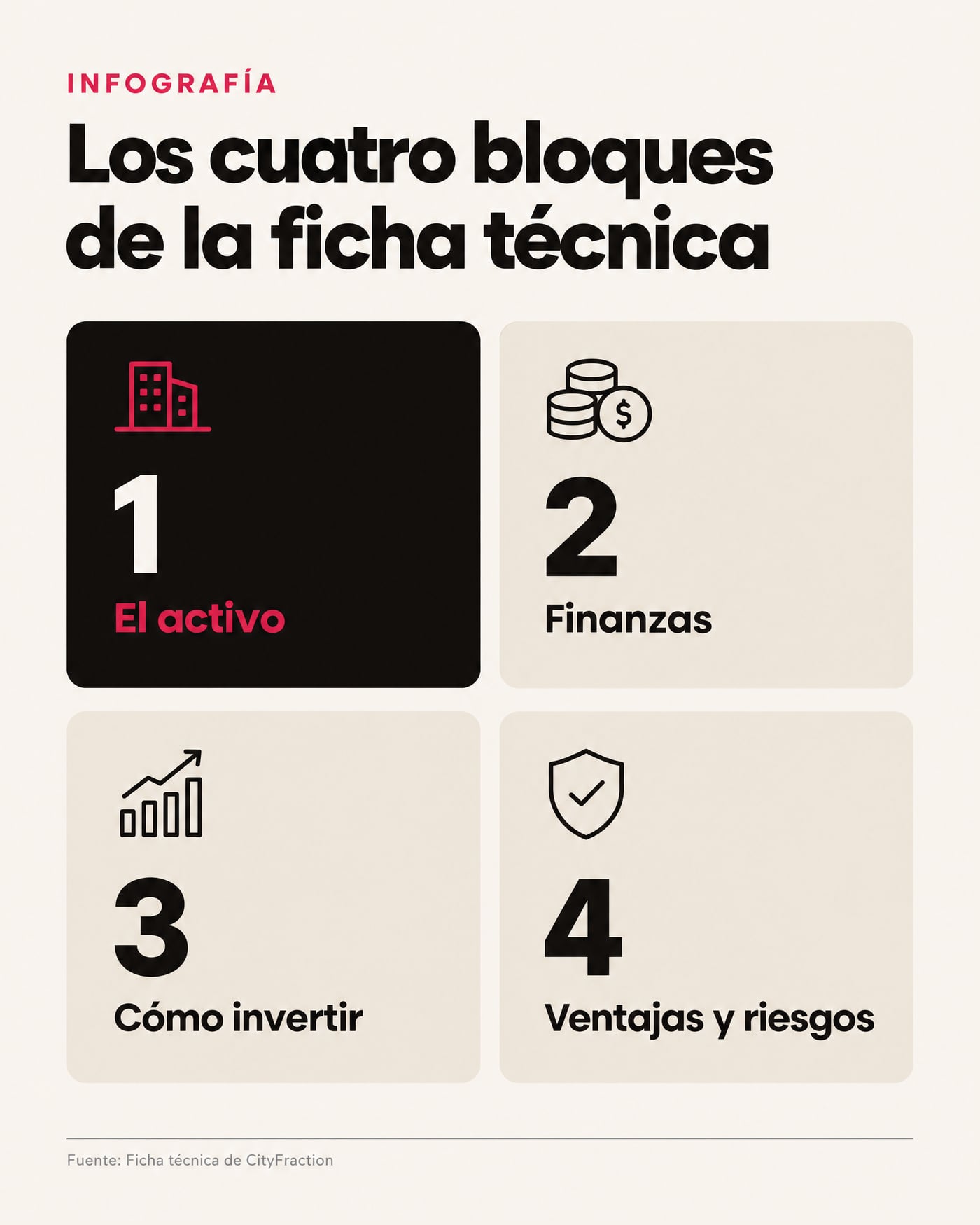
- The CityFraction technical sheet has four sections: the asset, the finances, how to invest, and advantages and risks.
- Annual return and appreciation are shown as estimates, not guarantees.
- The horizon of each asset indicates the expected term, which can be extended up to 24 months.
- The sheet is complemented by the participation contract, which you sign when buying.
Infographic
The four blocks of the data sheet
View data in table
| The asset | 1 |
| Finance | 2 |
| How to invest | 3 |
| Advantages and risks | 4 |
Source: CityFraction data sheet
Why read the sheet
The technical sheet is a summary of everything you need to know about an asset before investing. On CityFraction, it can be viewed on each asset's page and downloaded as a PDF. Reading it carefully, and not just looking at the return, is the most important step to invest wisely.
Section 1: the asset
Describes exactly what it is: a lodging or a car, its location, type, rental strategy, condition, and features. Here, it's worth asking if the location has demand, if the asset is operating or not yet, and who operates it.
- City and area.
- Asset type and strategy (short-term rental, car rental, traditional rental).
- Status: available, coming soon, or financed.
- Operator responsible for daily management.
Section 2: the finances
Shows the total value of the asset, number of fractions, price per fraction, estimated annual return, estimated appreciation, assumed occupancy, operator's commission, and maintenance reserve. This is the most technical and important part.
Return and appreciation figures are estimates based on occupancy, rates, and cost data. They are not guaranteed and may vary. Ask yourself if the occupancy and rate assumptions are reasonable for that city and season.
| Data | Key question |
| Price per fraction | How many fractions can I buy with my budget? |
| Estimated annual return | Is it net of costs? What occupancy is assumed? |
| Estimated valuation | Is it reasonable for that market? |
| Assumed occupancy | Does it match city data? |
| Operator's commission and reserve | How much is deducted before distribution? |
| Horizon | Can I maintain the investment for that time? |
General reading guide.
Block 3: how to invest
Explains the process: create the account, choose the asset and fractions, pay with the preferred method, sign the contract electronically, follow the portfolio and collect the rent, and sell or withdraw when needed. It’s useful to understand when you become the owner and when you start receiving rent.
Block 4: advantages and risks
Summarizes what makes the asset attractive and what can go wrong. Read the risks carefully: demand, regulation, maintenance, liquidity, exchange rate, and market value. If a risk isn’t clear, ask before investing.
All investments carry risks, including capital loss. The returns of CityFraction assets are estimated and not guaranteed.
The participation contract
The data sheet is complemented by the participation contract, which you sign electronically when buying. The contract establishes your rights over net income and the proceeds from the final sale of the asset, the term, the possibility of early sale with at least 30 days’ notice and an independent valuation, extension up to 24 months, and the success fee if the data sheet mentioned it. It’s worth reading it fully.
If you have doubts about a clause, check the FAQs or write to us before buying.
Common mistakes when reading a data sheet
The most frequent mistake is looking only at the estimated return and comparing it with other assets without reviewing the assumptions. Two assets with the same figure can have very different risks: one may depend on optimistic occupancy or a single season, and another may have higher maintenance costs due to its age.
Another mistake is ignoring the horizon. If you need the money in a year and the asset has a planned term of five, you may be forced to sell on the secondary market at a bad time. That’s why the data sheet should be read completely, from start to finish, and compared with your own goals and timelines.
Conclusion
A good investment decision starts with reading. The data sheet tells you what you’re buying, how much it could yield based on assumptions, how much it costs, and what risks you assume. Take the time to read it for each asset and compare several before deciding.
Frequently asked questions
Where is an asset’s data sheet?
On each asset’s page, with an option to download it as a PDF.
Is the return in the data sheet guaranteed?
No. It’s an estimate based on occupancy, rates, and costs, and it can vary.
What happens if the asset isn’t sold at the end of the term?
The term can be extended up to 24 months if the market doesn’t allow selling at a reasonable value.
Fonts
Public data consulted for this item. Figures may be updated after the consultation date.
- 1.CityFraction: frequently asked questions (fees, rents, and terms) · consultado el October 12, 2026
Explore open properties
Accommodations with fractions from 50 USD.
Conversation
What do you think of this article?
Educational content. Returns and figures are estimates or illustrative examples and do not constitute advice or guarantee. Read the risk information.