
Taxes
U.S. Income and the W-8BEN Form: The Basics of the 30% Withholding
If you receive U.S.-source income without living in the United States, it’s important to understand the 30% withholding and the W-8BEN form.
November 10, 2026 4 min readCityFraction editorial team
Key points
- The default withholding for non-residents on U.S.-source passive income (FDAP) is 30%.
- A tax treaty can reduce or exempt that rate.
- The W-8BEN form is used to certify foreign status and claim treaty benefits.
- It generally must be renewed every three years or sooner if residency changes.
Infographic
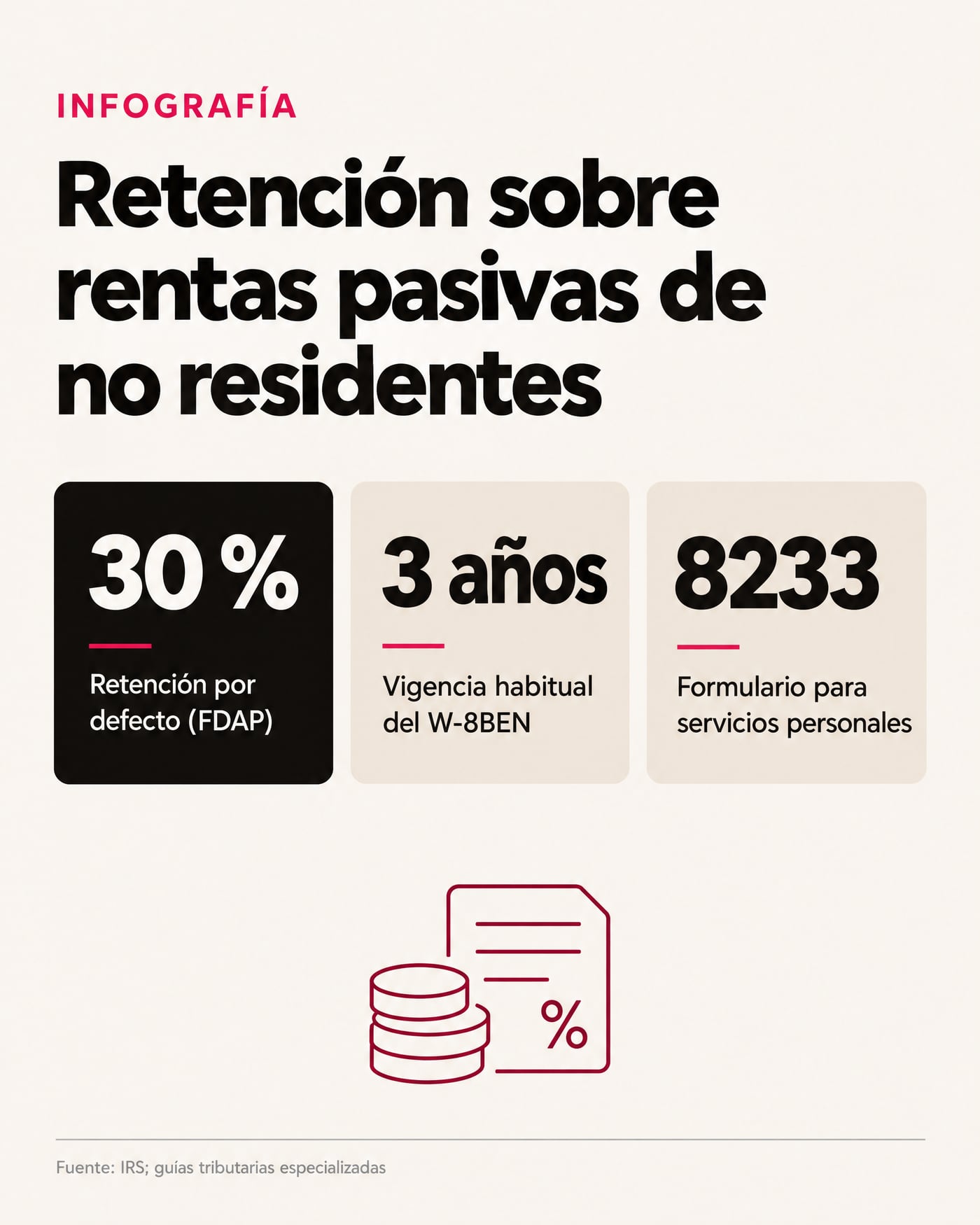
Withholding on passive income of non-residents
View data in table
| Default withholding (FDAP) | 30 % |
| Typical validity of the W-8BEN | 3 years |
| Form for personal services | 8233 |
Source: IRS; specialized tax guides
What FDAP income is
The U.S. tax system calls FDAP (fixed, determinable, annual or periodical) income fixed, determinable, annual, or periodic income: dividends, interest, royalties, rents, and other passive income. When a non-resident receives this type of U.S.-source income, a 30% withholding applies by default, unless a tax treaty establishes a lower rate or exemption.
This rule does not apply equally to all income: income connected to a U.S. business or gains from real estate sales have different treatments.
What the W-8BEN form is
According to the IRS, a person receiving income that is not payment for personal services can claim treaty benefits by submitting the W-8BEN form to the withholding agent. For personal services, a different form, 8233, is used.
To apply a reduced rate, the beneficiary generally must provide a tax identification number and certify that they reside in a treaty country, are the beneficial owner of the income, and comply with the treaty’s terms. According to financial institutions, the form is usually renewed every three years or sooner if the country of residence changes.
| Concept | General rule |
| Passive income (FDAP) of non-residents | 30% withholding |
| With applicable tax treaty | Reduced rate or exemption |
| Form for passive income | W-8BEN |
| Form for personal services | 8233 |
| Typical validity of the W-8BEN | 3 years |
Sources: IRS and specialized tax guides. Does not constitute advice.
Colombia and the United States
At the time of writing this article, Colombia did not have a general treaty to avoid double taxation with the United States, unlike other countries in the region. This means that W-8BEN treaty benefits are not always available for Colombian residents. Other countries do have treaties, and the applicable rate depends on each one. Therefore, it is essential to review the specific case with an advisor.
How it relates to investing in fractions
The tax treatment of income from a fraction depends on the legal structure of the asset, the country where it is located, the type of income, and your tax residency. CityFraction provides information in the data sheet and contract of each asset about its structure, and delivers extracts for your accounting, but does not offer tax advice.
- Identify your tax residency.
- Check if your country has a treaty with the United States.
- Keep the withholding certificates you receive.
- Declare foreign-source income in your country if applicable.
- Consult a professional before investing significant amounts.
Risks and warnings
International tax rules are complex and change. A misinterpretation can lead to penalties or double payments. This article is a general introduction.
This is not tax advice. All investments carry risks, including capital loss. The returns of CityFraction assets are estimated and not guaranteed.
Withholding is not the same as final tax
Withholding is an advance payment made by the payer on behalf of the beneficiary. In some cases, it matches the final tax; in others, the beneficiary can file a U.S. tax return, form 1040-NR, to recover any excess withholding if a lower rate applied. It can also happen that in their country of residence they must declare the income and deduct the tax paid abroad.
Understanding this difference avoids surprises: what you see withheld on a payment is not always the full tax, nor always final. That’s why advisors recommend keeping all withholding certificates and reviewing them each year with a professional familiar with the regulations of both countries.
Conclusion
The 30% withholding is the default rule for passive income of non-residents in the United States, and treaties can reduce it. Understanding this helps you ask better questions to your accountant and compare investments with their taxes included.
Frequently asked questions
How much does the United States withhold from a non-resident?
By default, 30% on passive income from U.S. sources (FDAP), unless a treaty reduces the rate.
What is the W-8BEN for?
To certify to the payer that you are a foreign person and, if applicable, claim the benefits of a tax treaty.
How often is the W-8BEN renewed?
Usually every three years, or sooner if your country of residence changes.
Fonts
Public data consulted for this item. Figures may be updated after the consultation date.
- 1.IRS: claiming tax treaty benefits (forms W-8BEN and 8233) · consultado el October 12, 2026
- 2.Taxes for Expats: FDAP income, what non-residents need to know · consultado el October 12, 2026
Explore open properties
Accommodations with fractions from 50 USD.
Conversation
What do you think of this article?
Educational content. Returns and figures are estimates or illustrative examples and do not constitute advice or guarantee. Read the risk information.