

Risks
National Tourism Registry: the rule for tourist housing in Colombia
Law 2068 of 2020 required platforms to remove listings without National Tourism Registry. We explain the regulation and the current debate.
October 30, 2026 4 min readCityFraction editorial team
Key points
- Registering with the National Tourism Registry (RNT) is a requirement to offer tourist housing in Colombia.
- Article 38 of Law 2068 of 2020 requires platforms not to publish listings without a valid RNT.
- According to the sector, since that law the number of RNT registrants has grown more than 109%.
- The Government is discussing a new decree with more controls; formality is an asset for the investor.
Infographic
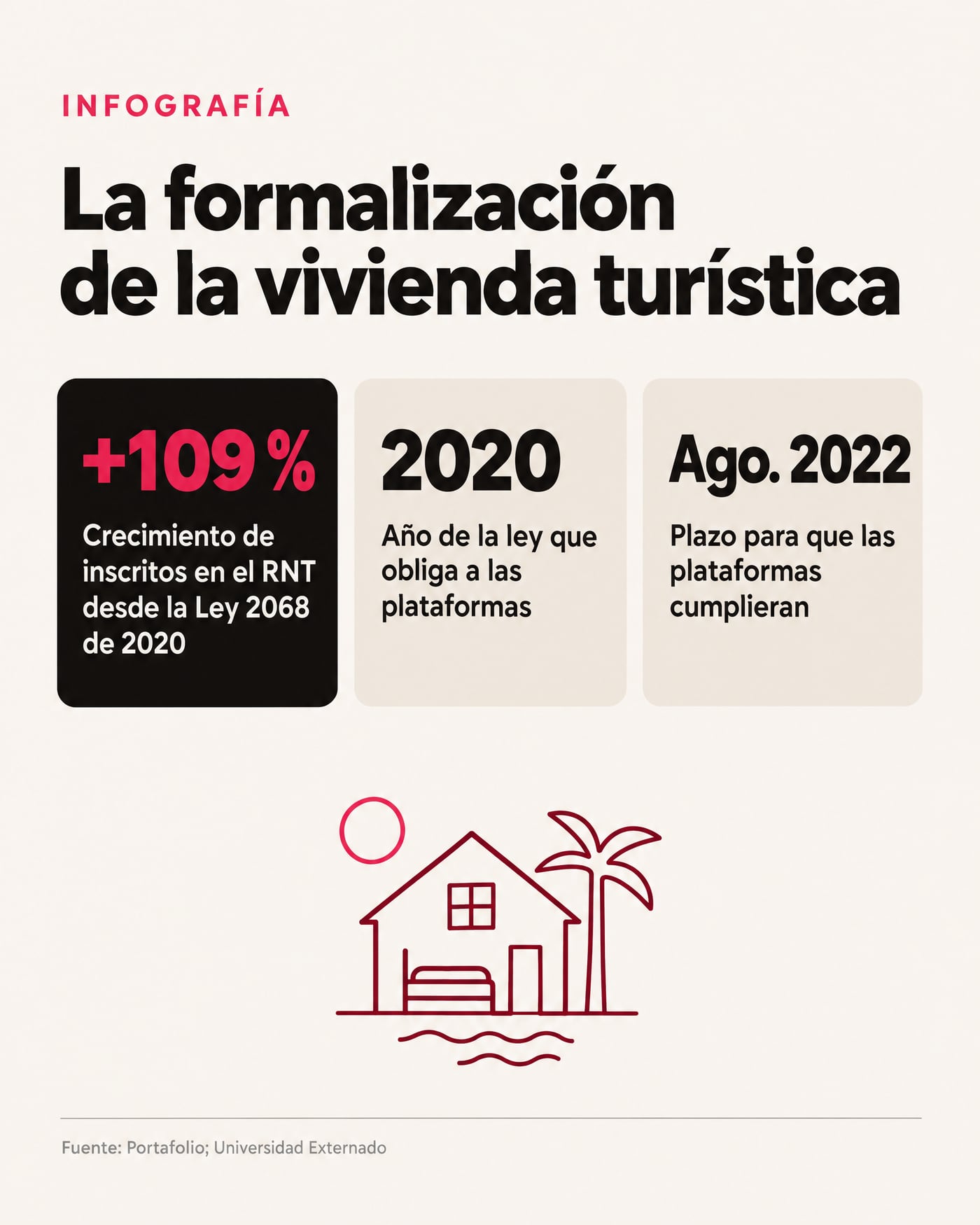
Formalization of tourist housing
View data in table
| Growth of RNT registrations since Law 2068 of 2020 | +109 % |
| Year of the law requiring platforms | 2020 |
| Deadline for platforms to comply | Aug. 2022 |
Source: Portafolio; Externado University
What is the National Tourism Registry
The National Tourism Registry (RNT) is the mandatory registration of tourism service providers in Colombia. It is managed by the Ministry of Commerce, Industry and Tourism with the support of chambers of commerce. To offer tourist housing, that is, a property rented by the day to travelers, the owner or operator must be registered.
The obligation comes from the General Tourism Law and its regulatory decrees, particularly Decree 1074 of 2015, and was reinforced by Law 2068 of 2020.
The change from Law 2068 of 2020
Law 2068 of 2020 took a key step: its article 38 requires digital platform operators not to publish or to remove listings from providers who do not have an active and valid RNT registration. The deadline to comply was extended until August 24, 2022.
In other words, the responsibility to verify the registration no longer falls solely on the authorities: platforms must also do so. According to figures cited by the sector, since the enactment of that law the number of RNT registrants grew more than 109%, doubling the number of formalized providers.
The current debate
The Ministry published a draft decree to amend Decree 1074 of 2015 regarding the RNT and platform obligations. According to a 2026 report by Universidad Externado, the proposal includes requiring registration for owners of non-hotel tourist housing and creating verification mechanisms with the support of chambers of commerce.
Some sector players have criticized the draft because, in their view, it would turn the registry into a licensing system and require commercial registration, besides requiring land use plans and condominium regulations to authorize the activity. At the time of writing this article the debate was still open, so it is advisable to check the current regulation in each case.
| Regulation or milestone | What it establishes |
| Decree 1074 of 2015 | Regulation of the commerce, industry and tourism sector |
| Law 2068 of 2020, art. 38 | Platforms cannot publish listings without a valid RNT |
| August 24, 2022 | Final deadline for platforms to comply |
| Draft decree (2025-2026) | More controls and verification with chambers of commerce |
Sources: Universidad Externado (2026 report) and Portafolio.
Why formality has value
A lodging without RNT can be removed from platforms, which are the main channel for short-term rental bookings. It can also face sanctions from tourism authorities. A formal lodging, on the other hand, can operate with peace of mind, invoice, pay its taxes, and build a stable reputation.
Additionally, formality usually goes hand in hand with better management: insurance, organized accounting, compliance with co-ownership rules, and professional guest service. All of this reduces risks for the investor.
Condominium regulations also matter
In Colombia, buildings and complexes are governed by their horizontal property regulations. These regulations may allow, limit, or prohibit tourist use of the units. And cities, through their land use plans, define in which zones the activity is permitted. A serious asset analysis reviews all three layers: RNT, building regulations, and land use.
- Current registration in the National Tourism Registry.
- Horizontal property regulations allowing tourist use.
- Land use compatible according to the city's land use plan.
- Payment of tourism taxes and parafiscal contributions.
Regulatory risks
Short-term rental rules change worldwide, and Colombia is no exception. A regulatory change can increase costs, require new procedures, or limit activity in certain areas. Diversifying across cities and countries spreads that risk.
All investments carry risks, including capital loss. The returns of CityFraction assets are estimated and not guaranteed.
Conclusion
Tourist housing in Colombia is moving from informality to formality. For investors, this is good news if they choose assets that already comply and have management capable of adapting. Before investing, check the asset's regulatory status in its profile.
Frequently asked questions
Do I need RNT to rent by the day in Colombia?
Yes. Registration in the National Tourism Registry is required to offer tourist housing.
Can Airbnb list a lodging without RNT?
No. Article 38 of Law 2068 of 2020 requires platforms not to publish listings without valid RNT.
Can the regulation change?
Yes. The government is discussing a new decree with more controls; therefore, it is advisable to review the current regulation.
Fonts
Public data consulted for this item. Figures may be updated after the consultation date.
- 1.Externado University: report on the regulation of tourist accommodations in Colombia (2026) · consultado el October 12, 2026
- 2.Portafolio: irregularities of the decree on tourist housing · consultado el October 12, 2026
Explore open properties
Accommodations with fractions from 50 USD.
Conversation
What do you think of this article?
Educational content. Returns and figures are estimates or illustrative examples and do not constitute advice or guarantee. Read the risk information.