

Short-term rental
Traditional rent vs. short-term rental: differences seen in the numbers
Is it better to rent by the month or by the night? We explain the differences in income, costs, risks, and regulation between both models.
November 24, 2026 4 min readCityFraction editorial team
Key points
- Traditional rent offers stable income with less management.
- Short-term rentals allow higher nightly rates but with variable occupancy and more costs.
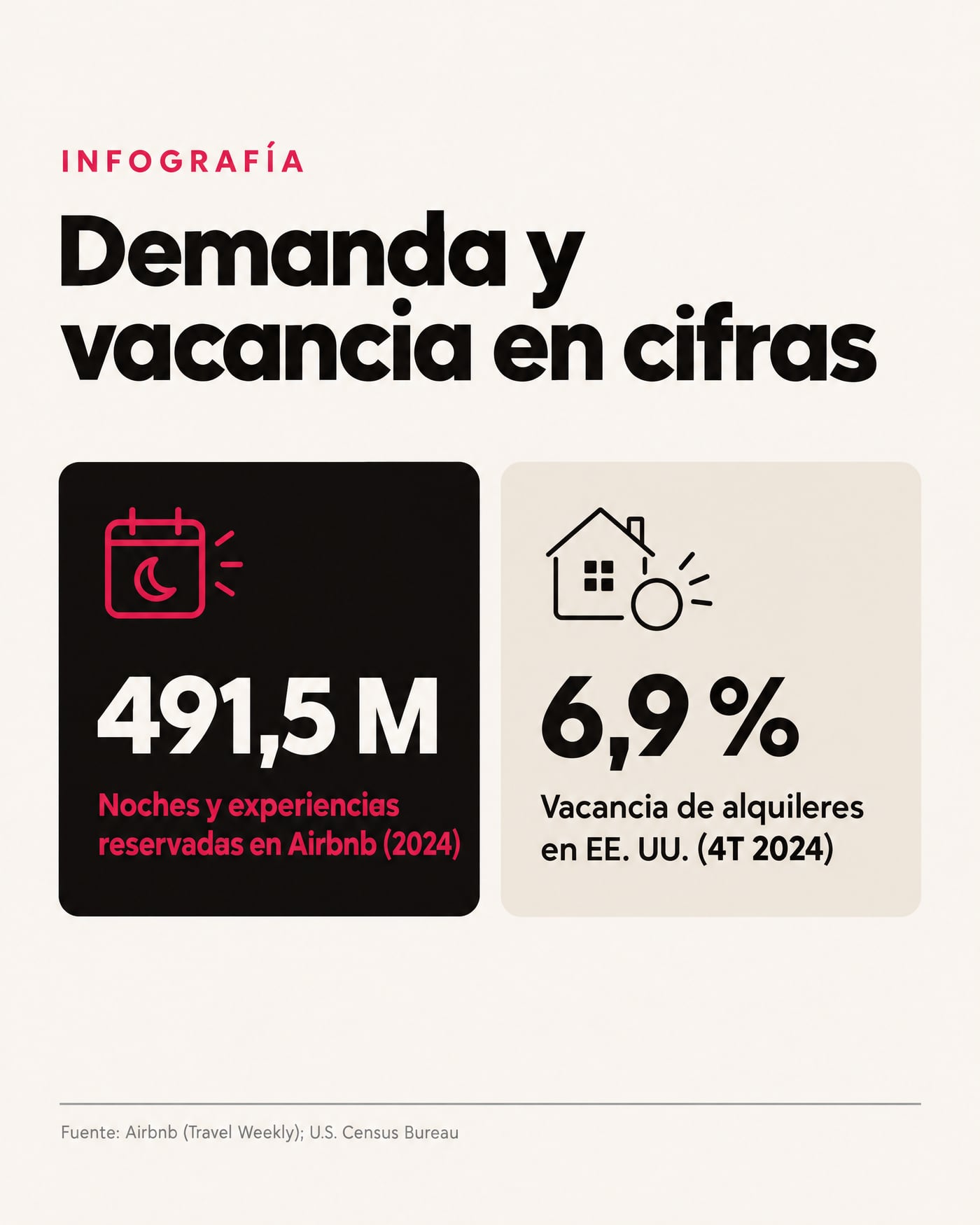
- Airbnb booked 491.5 million nights in 2024; US rental vacancy was 6.9%.
- Short-term rental regulation is stricter and changes frequently.
Infographic
Demand and vacancy in numbers
View data in table
| Nights and experiences booked on Airbnb (2024) | 491,5 M |
| Rental vacancy in the U.S. (Q4 2024) | 6,9 % |
Source: Airbnb (Travel Weekly); U.S. Census Bureau
Two ways to rent a property
A property can generate income in two main ways. In traditional rent, a tenant occupies it for months or years and pays a fixed rent. In short-term rental, the property is rented by the night to travelers through platforms like Airbnb or Booking.
Neither is better in all cases. Each model has a different profile of income, costs, risks, and work.
Income: stability versus potential
Traditional rent offers predictable income while the contract is active, although when the tenant leaves there can be months without rent. In the US, rental vacancy was 6.9% in Q4 2024, according to the Census Bureau.
Short-term rental allows charging more per night and adjusting prices to demand, so in good markets it can generate more gross income. In exchange, occupancy varies day by day and by season. Demand exists at large scale: Airbnb booked 491.5 million nights and experiences in 2024.
Costs: the factor that changes the comparison
Short-term rental has more costs: cleaning after each stay, laundry, supplies, platform commissions, guest service, more frequent maintenance, and often tourist taxes. Traditional rent has fewer operating costs, although the owner still bears taxes, major maintenance, and vacancy periods.
| Aspect | Traditional rent | Short-term rental |
| Income | Fixed monthly | Variable per night |
| Occupation | High while contract lasts | Variable by season |
| Operating costs | Low | High |
| Management | Low | High and daily |
| Regulation | Lease rules | Registrations, licenses, and tourist taxes |
| Price flexibility | Low | High |
General comparison; each property and market is different.
Risks of each model
- Renting: tenant default and lengthy eviction processes.
- Renting: rent capped by contract and local regulations.
- Short-term rental: demand drops and seasonality.
- Short-term rental: regulatory changes and platform dependence.
- Both: vacancy, damages, taxes, and real estate market.
Why CityFraction focuses on short-term rentals
CityFraction’s assets are mainly short-term rental accommodations in tourist destinations and cars rented by the day. By fractionalizing them, daily management is handled by a professional operator and investors receive their share of net income each day. The platform also offers traditional rental assets, which appear in the catalog when available.
All investments carry risks, including capital loss. The returns of CityFraction assets are estimated and not guaranteed.
How to decide what suits you
If you want stable income with little variation, the traditional model may fit better. If you accept more variation for higher income potential and exposure to tourist destinations, short-term rentals could be an option. Many investors combine both to balance their portfolio.
In any case, always compare estimated net returns, not gross income, and review assumptions on occupancy, rates, and costs.
A simplified example
Imagine an apartment that could rent for 1,000 dollars per month traditionally, with very low operating costs. The same apartment as a short-term rental could charge 120 dollars per night. With 60% occupancy, it would rent about 18 nights per month, i.e., 2,160 dollars gross. But cleaning, commissions, utilities, guest services, and maintenance must be deducted, which can consume a significant part of that income.
The net result of short-term rental can be higher, equal, or lower than traditional renting depending on actual occupancy, rates, and costs. The example is illustrative and not based on a real asset: it shows why net income must always be compared, not gross.
Conclusion
Short-term rentals can generate more income than traditional renting, but with higher costs, more work, and more risk. Understanding these differences helps you choose assets aligned with your goals and risk tolerance.
Frequently asked questions
Does short-term rental always earn more than renting?
No. It can generate higher gross income but has more costs and variability; it depends on each property and market.
What costs does short-term rental have?
Cleaning, laundry, supplies, platform commissions, guest services, maintenance, and tourist taxes.
Who manages CityFraction’s accommodations?
A professional operator; the investor receives their share of net income each day.
Fonts
Public data consulted for this item. Figures may be updated after the consultation date.
- 1.U.S. Census Bureau: Housing Vacancies and Homeownership, fourth quarter 2025 · consultado el October 12, 2026
- 2.Travel Weekly: Airbnb outpaced travel sector growth in 2024 · consultado el October 12, 2026
- 3.CityFraction: frequently asked questions (fees, rents, and terms) · consultado el October 12, 2026
Learn how it works
The model, how to invest, and how to withdraw, step by step.
Conversation
What do you think of this article?
Educational content. Returns and figures are estimates or illustrative examples and do not constitute advice or guarantee. Read the risk information.