

Cars
Turo in numbers: 3.5 million guests and 1.5 billion for hosts
Turo is the largest peer-to-peer car rental platform. We review its 2024 figures and what they imply for investing in cars.
November 2, 2026 4 min readCityFraction editorial team
Key points
- Turo closed 2024 with 3.5 million active guests and 340,000 active vehicles.
- It generated 2.5 billion dollars in bookings and 1.5 billion in earnings for hosts.
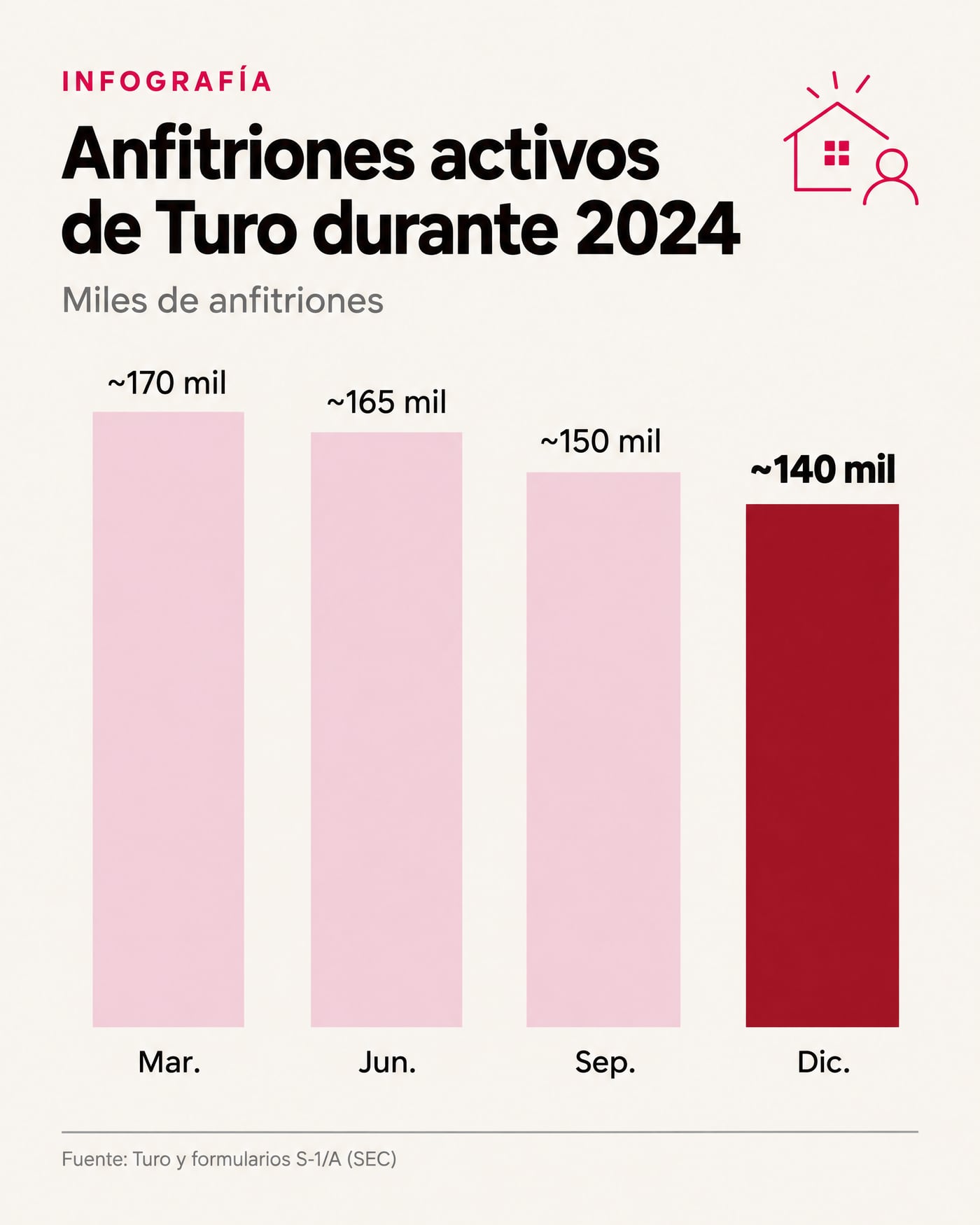
- The number of active hosts dropped from about 170,000 in March to about 140,000 by the end of the year.
- Rental cars have their own risks: depreciation, accidents, and platform changes.
Infographic
Active Turo hosts during 2024
Thousands of hosts
View data in table
| Mar. | ~170 mil |
| Jun. | ~165 mil |
| Sep. | ~150 mil |
| Dec. | ~140 mil |
Source: Turo and S-1/A forms (SEC)
The shared car platform
Turo is an online marketplace where owners rent out their cars to travelers and residents, similar to how Airbnb does with accommodations. According to the company itself, it closed 2024 with 3.5 million active guests, 140,000 active hosts, and 340,000 active vehicles.
The company also reported 2.5 billion dollars in gross booking value and 1.5 billion in earnings for hosts during 2024.
Fewer hosts, more professionalism
The forms submitted to the SEC show an interesting trend: active hosts went from about 170,000 in March 2024 to about 165,000 in June, about 150,000 in September, and about 140,000 by year-end, while active vehicles remained around 340,000 to 365,000.
Fewer hosts with a similar number of cars suggests that each host manages more vehicles on average, meaning the market is becoming more professional. The sources do not explain the cause of the decline, so it should be read with caution.
| Date | Active hosts | Active vehicles |
| March 2024 | ~170.000 | — |
| June 30, 2024 | ~165.000 | ~365.000 |
| September 30, 2024 | ~150.000 | ~350.000 |
| End of 2024 | ~140.000 | ~340.000 |
Sources: Turo (corporate blog) and S-1/A forms filed with the SEC.
How a car generates income on Turo
A car on Turo earns money for each day it is rented. Its net income depends on the daily rate, the days rented per month, and costs: platform commission, insurance, maintenance, cleaning, deliveries, depreciation, and possible repairs. Cities like Miami, with international tourism and an airport handling nearly 56 million passengers a year, have high demand for rental cars.
- Daily rate by model, season, and demand.
- Days rented per month (occupancy).
- Platform commission and protection plan cost.
- Maintenance, tires, cleaning, and deliveries.
- Vehicle depreciation with use and age.
Depreciation, the hidden cost
Unlike real estate, a car loses value over time and mileage. According to the iSeeCars study on cars sold between March 2024 and February 2025, an average car loses 45.6% of its value in five years. That’s why the profitability of a rental car must be measured by subtracting that loss in value, not just adding income.
Some models retain their value better than others. Choosing the vehicle is as important as its occupancy.
Risks of rental cars
Besides depreciation, there are risks of accidents, theft, fines, and damage from use. Changes in platform rules or commissions also affect income. And demand depends on tourism and the local economy.
All investments carry risks, including capital loss. The returns of CityFraction assets are estimated and not guaranteed.
Turo versus a traditional agency
The main difference with a rental agency is that on Turo each car belongs to a host, who sets their price, rules, and availability. This allows offering models that an agency wouldn’t have, from family cars to sports cars, and adjusting the rate to daily demand. For the traveler, it means more variety; for the host, more control over the business.
The trade-off is that the quality of service depends on each host. Those who manage professionally, with punctual deliveries, clean cars, and good communication, receive better reviews and more bookings. At CityFraction, cars are operated with that approach, and the daily rent of each fraction reflects the real results of each vehicle.
Participate with fractions
At CityFraction you can buy fractions of cars rented on Turo in Miami from 50 USD and receive your share of the net income every day. It's a way to diversify beyond real estate, with a different risk and term profile.
Frequently asked questions
How many users does Turo have?
It closed 2024 with 3.5 million active guests and 140,000 active hosts, according to the company.
How much did Turo hosts earn in 2024?
Turo reported 1.5 billion dollars in earnings for hosts.
Does a rental car lose value?
Yes. According to iSeeCars, an average car loses 45.6% of its value in five years; this is a cost that must be considered.
Fonts
Public data consulted for this item. Figures may be updated after the consultation date.
- 1.Turo Inc., Form S-1/A (SEC) · consultado el October 12, 2026
- 2.Motor1: cars with the highest depreciation in 2025 (iSeeCars study) · consultado el October 12, 2026
- 3.Miami-Dade County: MIA records passenger record in 2024 (AviationPros) · consultado el October 12, 2026
See cars for rent
Car fractions rented on Turo, in Miami.
Conversation
What do you think of this article?
Educational content. Returns and figures are estimates or illustrative examples and do not constitute advice or guarantee. Read the risk information.