
Trends
1.4 billion tourists: the global demand map
Global tourism returned to pre-pandemic levels in 2024. We review the UNWTO barometer and its insights for investing.
November 19, 2026 4 min readCityFraction editorial team
Key points
- UNWTO estimated about 1.4 billion international tourists in 2024, 11% more than in 2023.
- Global tourism recovered 99% of its 2019 level.
- Europe, Middle East, and Africa exceeded pre-pandemic levels; the Americas were at 97%.
- Global travel demand supports the destinations where the assets are located.
Infographic
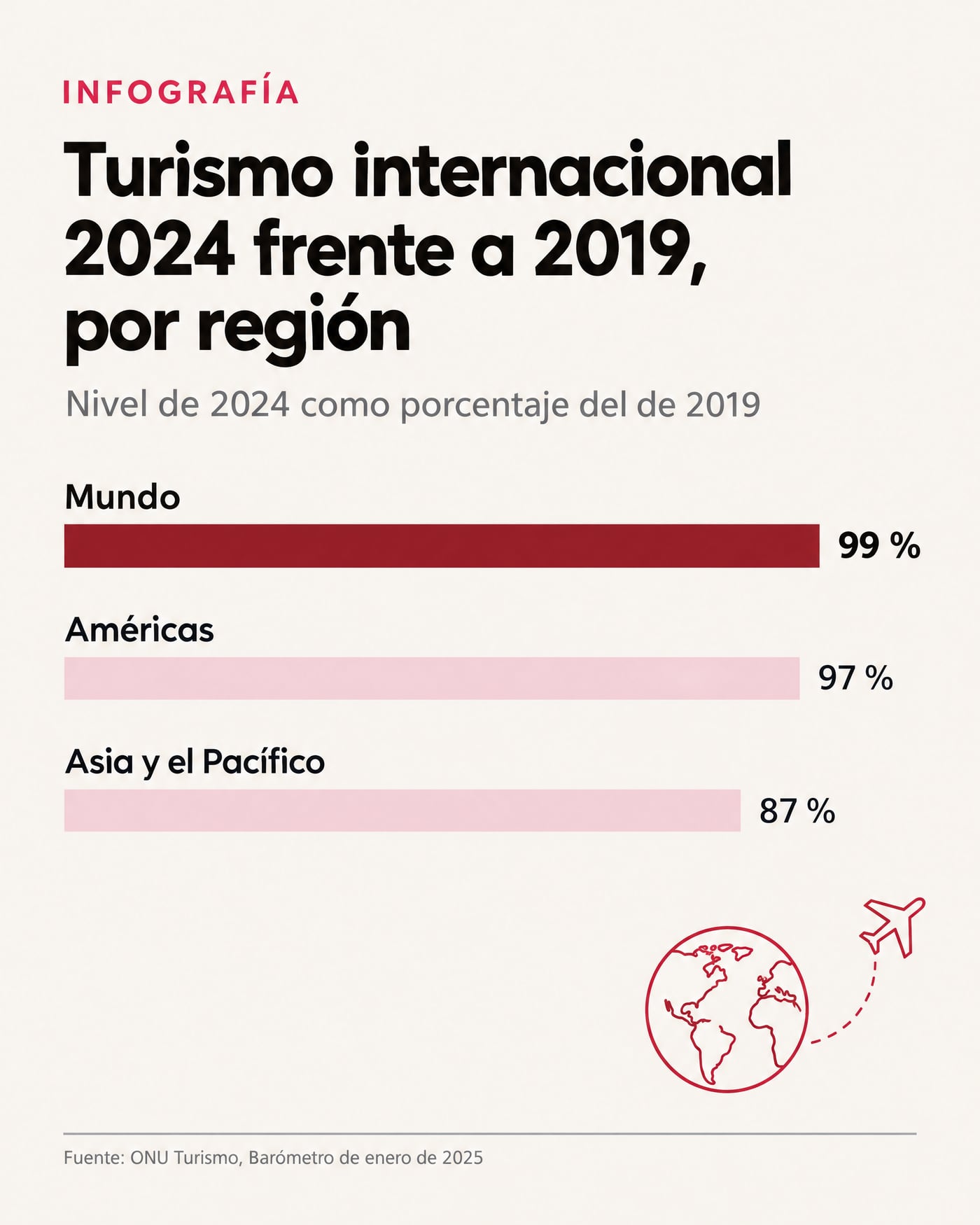
International tourism 2024 vs 2019, by region
2024 level as a percentage of 2019
View data in table
| World | 99 % |
| Americas | 97 % |
| Asia and the Pacific | 87 % |
Source: UNWTO, January 2025 Barometer
The near-complete recovery
According to the UNWTO World Tourism Barometer from January 2025, around 1.4 billion international overnight tourist arrivals were recorded worldwide in 2024, 11% more than in 2023, about 140 million more.
With that figure, international tourism practically recovered 99% of pre-pandemic levels, and most destinations surpassed their 2019 numbers.
An uneven map
The recovery was not the same everywhere. Europe, Middle East, and Africa exceeded 2019 levels in 2024. The Americas were close, 3% below, and Asia and the Pacific remained 13% below pre-pandemic figures.
That diversity matters: a portfolio with assets in Europe and the Americas benefits from different regional dynamics.
| Region | Status compared to 2019 |
| Europe | Above |
| Middle East | Above |
| Africa | Above |
| Americas | −3 % |
| Asia and the Pacific | −13 % |
| World | 99% of the 2019 level |
Source: UNWTO, World Tourism Barometer, January 2025.
CityFraction destinations on that map
The four markets where CityFraction operates show record figures: Spain received 93.8 million international tourists in 2024 and 96.77 million in 2025, according to INE; Italy recorded 466.2 million overnight stays in 2024, according to ISTAT; Colombia received 6.7 million non-resident visitors in 2024, according to MinCIT; and Miami-Dade surpassed 28 million visitors, according to its tourism office.
These are markets with diversified international demand, each with its own seasonality and risks.
What drives tourism
- Growth of the middle class in emerging economies.
- More air routes and low-cost airlines.
- Remote work and longer trips.
- Interest in experiences, gastronomy, and culture.
- Sports events, fairs, and international congresses.
Global tourism risks
Tourism is one of the sectors most sensitive to crises: pandemics, conflicts, natural disasters, recessions, or fuel price changes can slow travel from one year to the next. The experience of 2020 proved this. That’s why rental income from tourist accommodations can vary greatly and is not guaranteed.
All investments carry risks, including capital loss. The returns of CityFraction assets are estimated and not guaranteed.
How to read global trends
Global figures help understand the general direction of demand, but decisions are made locally. One destination can grow while another in the same region stagnates due to security, regulation, or competition. That’s why it’s best to combine global reading with data from each city and the performance of each asset.
UNWTO publishes its barometer several times a year and is a good reference to track how international tourism evolves by region.
Today’s traveler
The traveler profile has also changed. More people combine work and vacation, travel outside traditional seasons, and look for accommodations with kitchens, space, and a local experience. This trend favors short-term rental apartments over hotel rooms in certain segments, especially for families, groups, and longer stays.
At the same time, travelers are more demanding: they compare prices, read reviews, and expect quick service. Accommodations that pay attention to these details capture a larger share of demand, while those that don’t fall behind even if their city’s tourism grows.
Conclusion
Global travel demand has returned strongly and already exceeds pre-pandemic levels in many regions. It’s a good context for short-term rentals, provided it’s combined with diversification and careful analysis of each asset.
Frequently asked questions
How many international tourists were there in 2024?
Around 1.4 billion, 11% more than in 2023, according to UNWTO.
Has tourism recovered from the pandemic?
Overall it reached 99% of 2019 levels, with differences by region.
Which region is still below 2019?
Asia and the Pacific, 13% below; the Americas were at 3%.
Fonts
Public data consulted for this item. Figures may be updated after the consultation date.
- 1.UNWTO: World Tourism Barometer, January 2025 · consultado el October 12, 2026
- 2.La Moncloa: Frontur and Egatur 2025 data (INE) · consultado el October 12, 2026
- 3.ISTAT: Tourist Flows, year 2024 · consultado el October 12, 2026
- 4.MinCIT: Colombia broke a new tourism record in 2024 · consultado el October 12, 2026
- 5.Greater Miami Convention & Visitors Bureau: 2024 visitor record (Hotel Online) · consultado el October 12, 2026
Explore open properties
Accommodations with fractions from 50 USD.
Conversation
What do you think of this article?
Educational content. Returns and figures are estimates or illustrative examples and do not constitute advice or guarantee. Read the risk information.