
Secondary market
Liquidity: selling a home vs. selling fractions
Liquidity is one of the biggest challenges in real estate. We explain how a fraction is sold and what limitations it has.
November 15, 2026 3 min readCityFraction editorial team
Key points
- Selling an entire property involves finding a buyer, negotiating, processing, and paying costs.
- Fractions can be sold on the secondary market, with a 2% commission for the seller.
- Instant sale costs 3% and does not guarantee a timeframe in the secondary market.
- Liquidity is not guaranteed: it depends on buyers being available.
Infographic
Exit operation costs
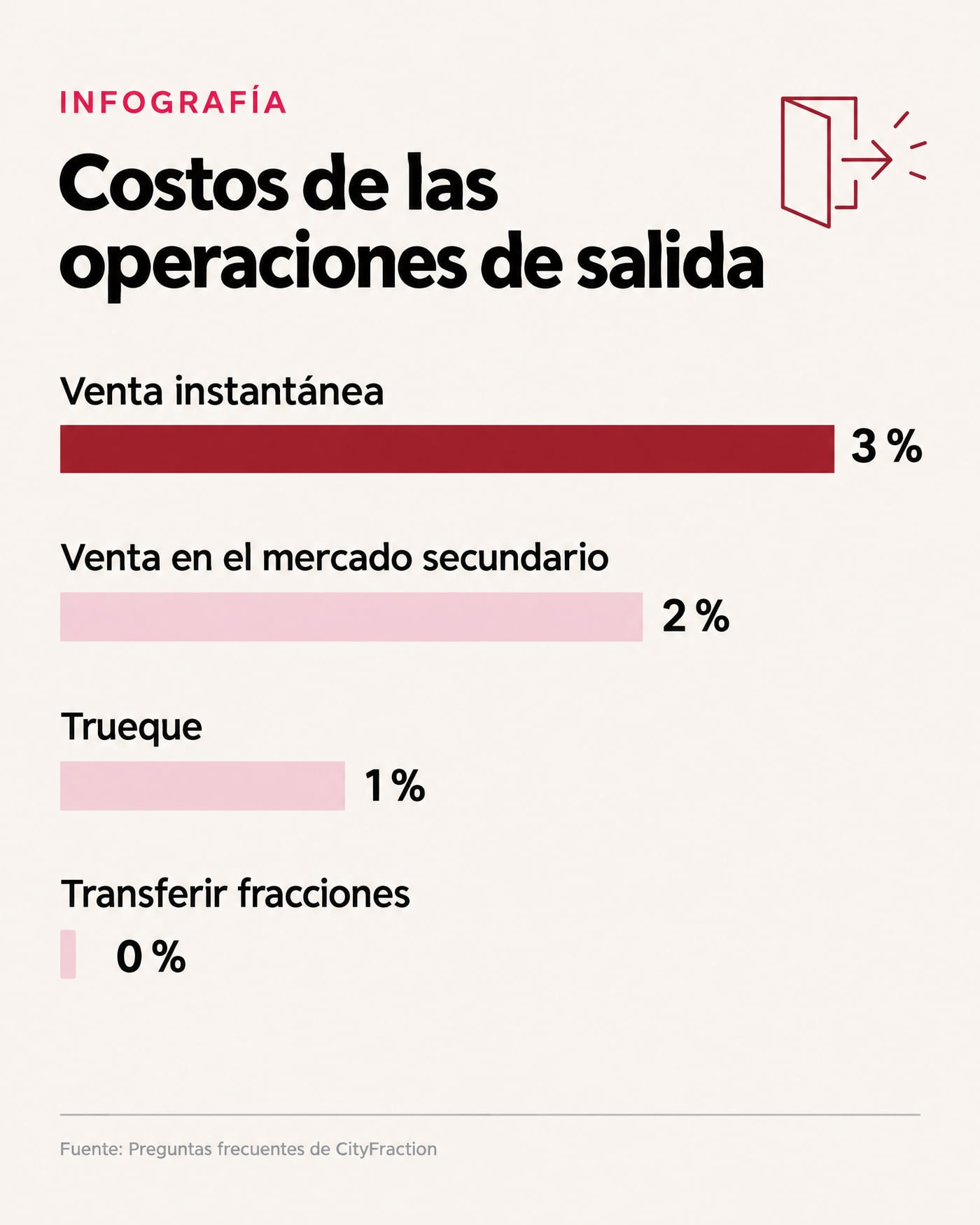
View data in table
| Instant sale | 3 % |
| Sale on the secondary market | 2 % |
| Swap | 1 % |
| Transfer fractions | 0 % |
Source: CityFraction Frequently Asked Questions
Liquidity, the weak point of real estate
A property is a valuable but illiquid asset. Selling it requires finding a willing buyer, agreeing on a price, waiting for buyer financing, and completing notarial and registry procedures. In Miami-Dade, for example, 10,738 single-family homes were sold in all of 2024, according to Miami Realtors: an active market, but each sale requires time and costs.
That lack of liquidity is why real estate is considered a long-term investment.
How a fraction is sold
Fractions improve part of that problem because they are sold in small parts and without notarial procedures. At CityFraction there are two paths. The first is the secondary market: you list your fractions and other users buy them. While the asset is not 100% sold in the primary market, secondary listings are made at 50 USD per fraction; after that, each seller sets their price.
The second is the instant sale, which allows selling without waiting for another user, at a higher cost.
| Operation | Cost |
| Fraction purchase | 0 % |
| Sale on the secondary market | 2% for the seller, on the sold amount |
| Instant sale | 3% on the sold value |
| Fraction swapping | 1% on the exchanged value |
| Transfer fractions | Free |
Source: CityFraction frequently asked questions. Always check the current commission table.
What is not guaranteed
The secondary market depends on demand: there is no guaranteed timeframe to sell a listing. If an asset is going through a rough patch, there may be few buyers or lower prices. At the end of each asset's term, the manager seeks to sell it and distributes the proceeds among the holders; this term can be extended up to 24 months if the market does not allow selling at a reasonable value.
Liquidity of fractions is not guaranteed. Every investment carries risks, including capital loss. Returns on CityFraction assets are estimated and not guaranteed.
Practical comparison
- Selling an entire property: months, intermediaries, notary, registry, and taxes.
- Selling fractions on the secondary market: from the platform, subject to buyers being available.
- Instant sale: faster, with a higher cost.
- Waiting until the end of the term: you receive the proportional part of the asset sale.
How to plan your exit
The best way to manage liquidity is to plan before investing. Invest in fractions money you won’t need in the short term and keep an emergency fund separate. If you know you’ll need part of the money by a certain date, consider staggering your investments or choosing assets with matching terms.
Diversifying among several assets also helps: if you need to sell, you can choose the one with the highest demand at that moment instead of relying on just one.
Why liquidity has a price
In financial markets, more liquid assets usually offer lower returns than less liquid ones because investors demand compensation for not being able to exit easily. Something similar happens with real estate: part of its long-term appeal comes from accepting that it cannot be converted to cash immediately. Fractions reduce this friction but do not eliminate it, so it’s best to view them as medium- or long-term investments.
Conclusion
Fractions make real estate more accessible and somewhat more liquid than an entire property, but they remain medium- or long-term investments. Knowing the rules and exit costs before buying is part of investing responsibly.
Frequently asked questions
Can I sell my fractions whenever I want?
You can list them on the secondary market or use the instant sale, but there is no guaranteed timeframe to find a buyer.
How much does it cost to sell on the secondary market?
2% seller fee on the actual sale amount.
What happens at the end of the asset’s term?
The manager seeks to sell the asset and distributes the proceeds among the holders; the term can be extended up to 24 months.
Fonts
Public data consulted for this item. Figures may be updated after the consultation date.
- 1.Miami Realtors: Miami-Dade market reports 2024 · consultado el October 12, 2026
- 2.CityFraction: frequently asked questions (fees, rents, and terms) · consultado el October 12, 2026
Explore open properties
Accommodations with fractions from 50 USD.
Conversation
What do you think of this article?
Educational content. Returns and figures are estimates or illustrative examples and do not constitute advice or guarantee. Read the risk information.