

Yield
Reinvesting income: compound interest explained with numbers
Compound interest is the most powerful force in long-term savings. We explain how it works when reinvesting income, with an illustrative example.
November 21, 2026 3 min readCityFraction editorial team
Key points
- Compound interest means generating returns on previous returns.
- Reinvesting income increases the base that generates new income.
- Inflation reduces real growth: in Colombia it was 5.10% in 2025.
- Examples with fixed rates are illustrative: the real income of an asset varies.
Infographic
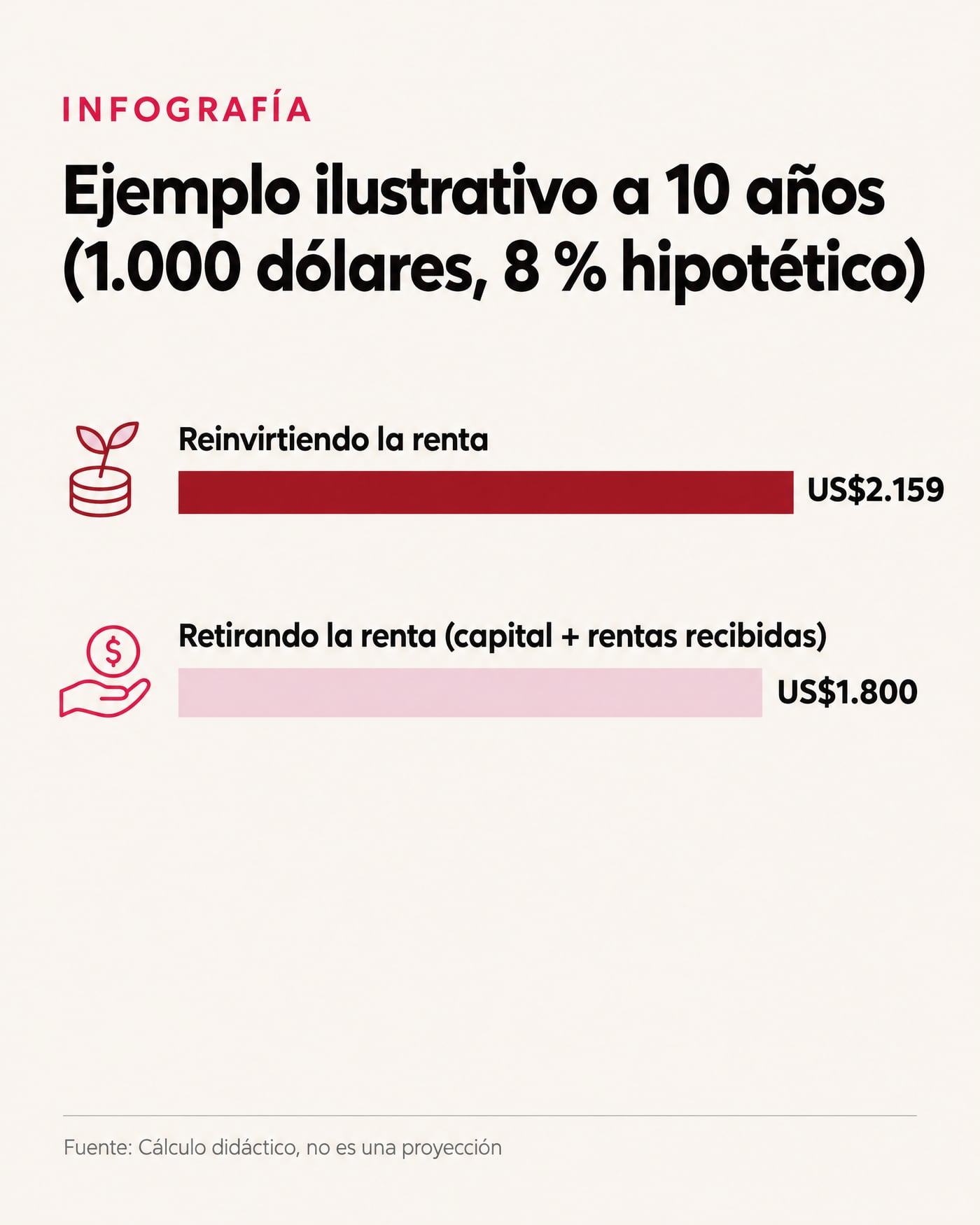
Illustrative example over 10 years (1,000 dollars, hypothetical 8%)
View data in table
| Reinvesting the rent | US$2,159 |
| Withdrawing the rent (principal + rents received) | US$1,800 |
Source: Educational calculation, not a projection
What is compound interest
When an investment generates income and that income is reinvested, the next income is calculated on a larger capital. That’s compound interest: returns generating new returns. Over time, the difference compared to always withdrawing income can be large.
The key lies in three variables: the initial amount, the rate of return, and especially time.
An example with numbers
Suppose an investment of 1,000 dollars with a hypothetical net return of 8% annually, constant, for educational purposes only. If you withdraw the income each year, after ten years you will have received 800 dollars and kept your 1,000 dollars. If you reinvest it, the capital grows each year on a larger base and by the end of the tenth year would be around 2,159 dollars.
The difference, about 359 dollars, comes solely from reinvesting. The example is illustrative: no real asset yields a fixed rate every year, and CityFraction’s returns are estimated and not guaranteed.
| Year | Withdrawing the income (accumulated received) | Reinvesting (capital) |
| 1 | US$80 | US$1,080 |
| 3 | US$240 | US$1,260 |
| 5 | US$400 | US$1,469 |
| 10 | US$800 | US$2,159 |
Educational calculation with a constant assumed rate. This is not a projection of any asset.
The effect of inflation
Nominal growth is not the same as real growth. If inflation is 5% and your investment yields 8%, your purchasing power grows by approximately 3% per year. In Colombia, inflation was 5.20% in 2024 and 5.10% in 2025, according to DANE. That’s why it’s always best to compare returns with inflation over the same period.
How to reinvest with fractions
At CityFraction, net income is credited to your balance daily. You can withdraw it or use it to buy new fractions, in the same asset or others. Reinvesting in different assets has an additional advantage: besides the compound effect, you diversify your portfolio.
- Check your accumulated income balance from time to time.
- Decide what portion to withdraw and what portion to reinvest.
- Use reinvestment to diversify across cities and asset types.
- Keep withdrawal fees in mind: the first withdrawal each month is free.
The limits of compound interest
Compound interest can also work against you: losses reduce the base on which future returns are generated. Also, income from real assets varies with occupancy, costs, and the market, and an asset can lose value. Reinvesting increases exposure to these risks.
All investments carry risks, including capital loss. The returns of CityFraction assets are estimated and not guaranteed.
Time, the most powerful variable
In any compound interest example, time matters more than the rate. Starting ten years earlier usually has more impact than gaining an extra percentage point of return. That’s why financial educators emphasize starting early, even with small amounts, and staying consistent.
Fractions from 50 USD allow you to start small and grow over time, combining new contributions and reinvestment of received income.
Conclusion
Reinvesting income is one of the simplest ways to grow wealth over the long term. Use it wisely: understanding that fixed-rate examples are educational, that inflation matters, and that diversification protects.
Frequently asked questions
What is compound interest?
Generating returns on previous returns by reinvesting income instead of withdrawing it.
Can I reinvest my income in CityFraction?
Yes. The rent is credited to your balance daily and you can use it to buy new fractions.
Is the 8% example a promise?
No. It is an educational calculation; the actual rent of each asset varies and is not guaranteed.
Fonts
Public data consulted for this item. Figures may be updated after the consultation date.
- 1.Bloomberg Línea: Colombia’s 2024 inflation was 5.20% (DANE) · consultado el October 12, 2026
- 2.Bloomberg Línea: Colombia’s inflation closed 2025 at 5.1% (DANE) · consultado el October 12, 2026
- 3.CityFraction: frequently asked questions (fees, rents, and terms) · consultado el October 12, 2026
Simulate your rent
See how much you could receive with your amount.
Conversation
What do you think of this article?
Educational content. Returns and figures are estimates or illustrative examples and do not constitute advice or guarantee. Read the risk information.